- Men lose collagen too — production declines gradually from the mid-twenties, without the sharp post-menopausal drop women experience.
- The strongest evidence for men is in joints and tendons: in a 12-week resistance training study, middle-aged men taking hydrolysed collagen saw tendon stiffness increase by 661 N/mm, nearly three times the 247 N/mm gain on placebo.
- Collagen is the same molecule with the same dose guidance regardless of sex — marketing it as a "women's product" is a branding decision, not a biological one.
- Most skin-collagen research has been conducted on women, so while the mechanism isn't sex-specific, skin benefits for men are less proven than joint and tendon benefits.
- In older men with sarcopenia, 12 weeks of collagen peptides plus resistance training added 4.2kg of fat-free mass, versus 2.9kg on placebo.
Collagen is marketed almost entirely to women, so it’s a fair question to ask: does it actually do anything for a man’s body, or is that just who the packaging is aimed at? The short answer is that collagen loss and collagen supplementation are not sex-specific processes. Men make and lose collagen the same way women do, and some of the strongest research on what supplementing it can do — particularly for joints and tendons — has been carried out specifically on men. Here’s what the evidence says, outcome by outcome.
Do men lose collagen too?
Yes. Collagen production declines for everyone, gradually, from around the mid-twenties onward — this isn’t a female-only process. What differs between the sexes is the shape of that decline, not whether it happens.
In women, oestrogen supports collagen production, so the loss accelerates sharply around menopause: research on menopause and connective tissue describes a strong correlation between skin collagen loss and the fall in oestrogen levels at that stage of life (Calleja-Agius & Brincat, 2012). Men have no equivalent hormonal turning point. There is no single life stage where men’s collagen production drops off a cliff — instead, the decline tends to be steadier and more continuous across midlife. This is genuinely the most interesting fact in the whole topic: it means a man in his forties has been losing collagen for roughly as long as a postmenopausal woman, just without the sudden acceleration.
The sex difference isn’t only about the rate of loss, either. A landmark 1975 study measuring skin collagen across a large group of adults found that collagen content was consistently lower in women than in men at every age studied, in addition to declining with age in both sexes (Shuster, Black & McVitie, 1975). Men start from a different baseline and lose collagen on a different curve — but they still lose it.
Isn’t collagen a women’s product?
No — that’s a marketing decision, not a biological one. The collagen peptides in a typical supplement are the same molecule whether a man or a woman takes them, hydrolysed collagen from the same sources (usually bovine or marine), broken down the same way in digestion, and absorbed the same way regardless of sex. Dose guidance doesn’t change based on who’s taking it either.
What has changed is who supplement brands choose to picture and speak to in their marketing. That’s a commercial choice, and plenty of brands are only now starting to shift it. It doesn’t reflect a difference in how the ingredient works. If anything, the research base skews the other way in places — some of the best-controlled studies on collagen’s effects on joints and tendons were conducted in all-male or majority-male samples, for reasons that have more to do with who volunteers for sports science trials than with who collagen is “for”.
Can men take collagen for joint and tendon health?
Yes, and this is where the evidence for men is strongest — stronger than for skin, hair or almost anything else collagen gets marketed for.
A 24-week trial of 147 competitive athletes (72 men, 75 women) found that those taking 10g of collagen hydrolysate daily reported significantly less joint pain — at rest, when walking, standing, carrying objects and lifting — than those on placebo, with the effect more pronounced in the subgroup who had existing knee pain (Clark et al., 2008). Because the sample was mixed-sex, it doesn’t isolate a male-specific effect, but it’s good evidence that collagen supplementation helps physically active people generally, men included.
More specific to men: a 2025 study gave 30g of hydrolysed collagen with vitamin C to middle-aged men (average age 47-48) undergoing 12 weeks of resistance training, and compared their patellar tendon adaptations with a placebo group doing the same training. The collagen group saw tendon stiffness increase by 661 N/mm, against 247 N/mm on placebo — nearly three times the gain — along with greater increases in tendon cross-sectional area and stiffness per unit of tension (Nulty, Phelan & Erskine, 2025). For men who train, particularly those in their forties and beyond whose tendons are working harder to keep up, this is a direct, male-specific result. If joint pain rather than tendon adaptation is what’s brought you here, our dedicated guide to collagen for joint health goes further into dosing and timing for that specific use.
Is collagen good for men’s skin?
Possibly, but be honest with yourself about the evidence: almost all of the skin research behind collagen’s reputation has been done in women, so it’s difficult to say with confidence how well it applies to men.
One of the better-designed trials — a double-blind, placebo-controlled study of oral collagen peptides on skin elasticity, moisture and roughness — enrolled 69 women aged 35 to 55 and found a statistically significant improvement in skin elasticity in the groups taking collagen, sustained even a month after stopping (Proksch et al., 2014). It’s a solid result, but it tells you about collagen and women’s skin specifically, not men’s. There’s no biological reason to think the mechanism — collagen peptides stimulating the skin’s own fibroblasts to produce more collagen — would behave differently in men, but until trials actually enrol men in meaningful numbers, skin benefits for men remain a plausible extension of the evidence rather than a proven one. Don’t let a headline claim about “reduced wrinkles” imply more than what’s actually been tested. Our breakdown of collagen for skin, hair and nails covers that evidence in more depth, sex differences and all.
What about hair and muscle recovery?
Of the outcomes covered here, hair has the weakest evidence base by some distance. There’s no well-controlled trial isolating collagen’s effect on hair thickness or growth in men specifically, and most of what circulates online about collagen and hair is inference from collagen’s role as a structural protein rather than direct evidence. If hair is your main reason for considering collagen, treat any claims about it with more scepticism than the joint or tendon evidence deserves.
Muscle recovery and strength training sit in a different category — this is one of the better-studied areas for men specifically. In a 12-week trial, 53 older men with sarcopenia (average age 72) who combined resistance training with 15g of daily collagen peptides gained 4.2kg of fat-free mass, compared with 2.9kg in the group doing the same training on placebo, along with greater gains in leg strength (Zdzieblik et al., 2015). That’s an older, sarcopenic population rather than younger or middle-aged men, so it doesn’t tell you what to expect if you’re 30 and already training hard — but it’s genuine evidence that collagen peptides can support muscle response to resistance training in men, on top of whatever protein you’re already getting from food.
How much collagen should men take?
The studies with the clearest results for men used daily doses in the 10-15g range of hydrolysed collagen, taken consistently for 12 weeks or longer before assessing any change — that’s true whether you’re looking at the joint pain trial, the tendon study or the muscle recovery trial above. There’s no separate dosing recommendation for men; the amount that’s shown benefit in research is the same regardless of sex, which is why our guide to how much collagen to take per day applies just as directly to you as to anyone else reading it.
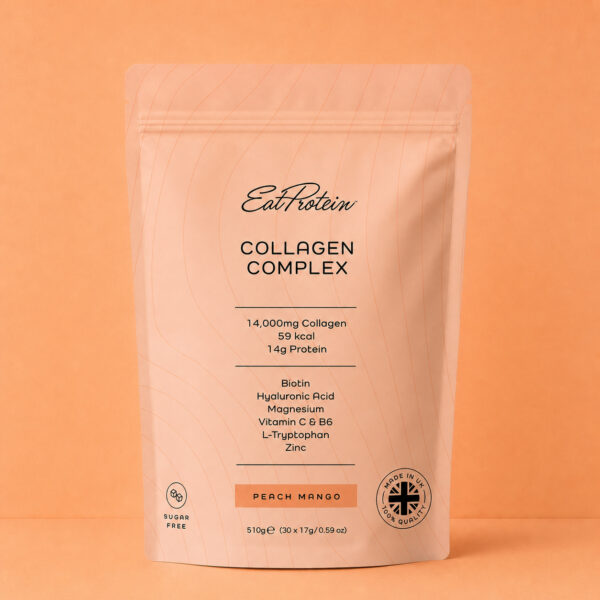
If you’re getting collagen through a powder rather than isolated peptides, check what you’re actually getting per serving — some products use doses well below what the research tested. EP’s Collagen Complex provides 14,000mg of hydrolysed collagen per scoop alongside 12g of complete protein, which covers the range used in the training and joint studies above without needing a second scoop.
Should men take collagen?
If you train regularly, are managing joint or tendon niggles, or are older and looking to support muscle mass alongside resistance work, the evidence for men is genuinely solid — stronger, in fact, than the evidence behind several supplements marketed specifically at men. If you’re mainly interested in skin or hair, it’s still worth trying, but go in with realistic expectations: the research supporting those outcomes was conducted almost entirely on women, and nobody has done the work yet to confirm it holds up the same way for men.
Either way, the case for or against taking collagen has nothing to do with your sex. It has to do with what you’re training for, what you’re managing, and whether you’re taking a dose that matches what was actually tested.
References
- Shuster S, Black MM, McVitie E (1975). The influence of age and sex on skin thickness, skin collagen and density. British Journal of Dermatology. View source
- Calleja-Agius J, Brincat M (2012). The effect of menopause on the skin and other connective tissues. Gynecological Endocrinology. View source
- Clark KL, Sebastianelli W, Flechsenhar KR, et al. (2008). 24-Week study on the use of collagen hydrolysate as a dietary supplement in athletes with activity-related joint pain. Current Medical Research and Opinion. View source
- Nulty CD, Phelan K, Erskine RM (2025). Hydrolysed collagen supplementation enhances patellar tendon adaptations to 12 weeks’ resistance training in middle-aged men. European Journal of Sport Science. View source
- Proksch E, Segger D, Degwert J, et al. (2014). Oral supplementation of specific collagen peptides has beneficial effects on human skin physiology: a double-blind, placebo-controlled study. Skin Pharmacology and Physiology. View source
- Zdzieblik D, Oesser S, Baumstark MW, et al. (2015). Collagen peptide supplementation in combination with resistance training improves body composition and increases muscle strength in elderly sarcopenic men: a randomised controlled trial. British Journal of Nutrition. View source