- There's no single "how long" answer — collagen works on different timelines depending on what you're tracking, from measurable skin changes at 4 weeks to a 24-week joint-pain trial.
- Skin gives the clearest early signal: dermal collagen density rose and fragmentation fell within just 4 weeks in a placebo-controlled trial, though visible hydration and wrinkle changes typically take 8–12 weeks.
- Nails respond more slowly — a 24-week trial found a 12% increase in nail growth rate and a 42% drop in broken nails, with results still improving 4 weeks after people stopped taking it.
- Joint comfort has the longest trial evidence: a 24-week study in 147 athletes found significantly less activity-related joint pain versus placebo, most pronounced in those with knee discomfort.
- Hair is the slowest and least-studied outcome of the four — there's currently no published human clinical trial giving a reliable timeline, only early cell and mouse research.
The honest answer: it depends what you’re measuring. Skin, nails, joints and hair respond to collagen on different timelines, because the underlying tissue turns over at different speeds — and because the trial evidence for each outcome runs for different lengths of time.
This guide walks through what the published research actually found, rather than giving you one tidy number for everything. Skin moves fastest. Nails and joints need a full season of daily use. Hair — honestly — doesn’t yet have solid human trial data behind any timeline.
How Long Does Collagen Take to Work?
The first measurable changes show up in skin, at the tissue level, from around 4 weeks of daily use, building to visible improvements by 8–12 weeks. Nails and joints move more slowly, with the strongest evidence coming from trials run over 24 weeks. Hair is the outcome with the least reliable human timeline of the four — there isn’t a solid clinical trial to point to yet.
That spread isn’t a dodge. Collagen supplementation supplies amino acids that your own cells use, over time, to build new collagen fibres — you’re not adding a finished structure. Skin cells turn over relatively quickly; nail and cartilage tissue is slower and denser. That’s exactly why the trials below ran for different lengths of time to detect a change.
How Long Does Collagen Take to Improve Skin Hydration and Elasticity?
Skin responds fastest of the four, with tissue-level changes detectable inside a month. In one placebo-controlled trial, dermal collagen density had already increased and fragmentation of the collagen network had already decreased by 4 weeks of daily supplementation — before it showed up as a hydration change you’d notice yourself.
Visible hydration improvements followed at 6–8 weeks in other trials, and by 8–12 weeks, wrinkle volume, elasticity, roughness and density had all improved significantly against placebo. An 8-week trial in 114 women found eye wrinkle volume significantly reduced at both the 4- and 8-week marks, reaching a 20% reduction by week 8, with the effect still measurable a month after stopping. A separate 12-week trial in 72 women found significant improvements across hydration, elasticity, roughness and density, largely retained even four weeks after people stopped taking the product.
Realistically: give skin at least 8 weeks before judging results, and expect the fuller picture — elasticity and texture, not just hydration — closer to the 12-week mark. For more on the skin, hair and nail benefits specifically, see our guide to collagen for skin, hair and nails.
How Long Does Collagen Take to Strengthen Nails?
Nails need longer than skin. The main evidence here comes from a 24-week trial, not an 8-week one. Twenty-five people with brittle nail symptoms took a daily collagen peptide dose for 24 weeks; by the end, nail growth rate had increased by 12% and the frequency of broken or cracked nails had fallen by 42%, with 64% of participants rated as clinically improved.
Results kept improving after people stopped taking it: 88% reported improvement four weeks after their last dose, up from 64% while still supplementing at 24 weeks. That’s a useful detail in itself — nail change is slow to show and slow to fade, which fits how gradually nail tissue actually grows. One caveat worth flagging: this was an open-label study with no placebo group, so it’s a weaker level of evidence than the placebo-controlled skin trials above — a real, physician-assessed result, but one to treat with a little more caution.
Practically, don’t expect any change inside the first month. Two to three months is a more realistic point to check whether your nails are peeling and breaking less.
How Long Does Collagen Take to Ease Joint Discomfort?
Joints are the other 24-week outcome, and the two trials available tell a more mixed story than skin or nails. In a randomised, placebo-controlled trial of 147 athletes with activity-related joint pain (97 with usable data), those taking a daily collagen hydrolysate dose for 24 weeks reported significantly less pain than the placebo group — at rest, when walking, standing, carrying and lifting — with the effect more pronounced in those with knee-specific discomfort.
A separate, smaller pilot trial in 30 people with mild knee osteoarthritis used MRI to track cartilage changes directly rather than relying on reported pain. It found a genuine biological signal — a cartilage marker linked to proteoglycan content improved significantly at 24 weeks in the collagen group, while it declined in the placebo group — but it did not find a statistically significant difference in reported symptoms between the groups. Worth being straight about: joints are the outcome where “a biological change happened” and “people felt it” don’t automatically arrive on the same evidence together. The pain-relief case is real, but both trials measured it as a single 24-week endpoint rather than a week-by-week breakdown, so there’s no earlier milestone in the research to point to. Joints are the slowest of the four to show a result — see our guide to collagen for joint health for more detail.
How Long Does Collagen Take to Affect Hair?
Of the four outcomes, hair has by far the thinnest human evidence — and, at the time of writing, no published clinical trial gives a reliable answer to “how long.” The research that exists is laboratory and animal work: a 2024 study found that a low-molecular-weight collagen peptide activated a hair-growth signalling pathway (Wnt/β-catenin) in human hair follicle cells grown in the lab, and stimulated hair growth when given orally to mice. That’s a genuinely interesting mechanistic finding, but it isn’t a human clinical trial, and it can’t tell you what to expect from your own hair on any given week.
If hair is your main reason for taking collagen, it’s fair to treat it as the slowest-showing and least certain of the four — and reasonable to keep expectations modest until proper human trial data exists.
Collagen Timeline at a Glance
Putting the trial evidence side by side makes the pattern clear: skin moves first, nails and joints need a full season of daily use, and hair doesn’t yet have a human timeline to plot at all.
| Timeframe | Skin (hydration & elasticity) | Nails | Joints | Hair |
|---|---|---|---|---|
| Weeks 1–4 | Dermal collagen density rising and fragmentation falling — a tissue-level change, not yet visible | No measurable change reported this early in the trial | No interim data reported at this stage | No human trial data at any stage |
| Weeks 4–8 | Hydration measurably improving; eye wrinkle volume significantly reduced | Underway, but not separately measured until later in the study | No interim data reported at this stage | No human trial data at any stage |
| Weeks 8–12 | Elasticity, roughness, density and wrinkle scores reach statistical significance | Ongoing — the main nail trial ran to 24 weeks, not 12 | No interim data reported at this stage | No human trial data at any stage |
| Weeks 12+ (to 24–28) | Improvements sustained for weeks after stopping supplementation | 24-week result: 12% faster nail growth, 42% fewer broken nails, still improving 4 weeks after stopping | 24-week result: significantly less joint pain in one trial; a cartilage marker improved in another, though that trial found no significant change in symptoms | Only cell and mouse-model evidence exists; no human timeline established |
Does Your Daily Dose Change How Fast Collagen Works?
Timeline and dose are two sides of the same question. Every trial above used a specific daily amount, and lower doses in the wider research tend to produce smaller, slower-emerging effects rather than the same result arriving sooner. If you want the detail on what amount the research actually links to these outcomes, our guide to how much collagen to take per day breaks down the dose ranges behind each result above.
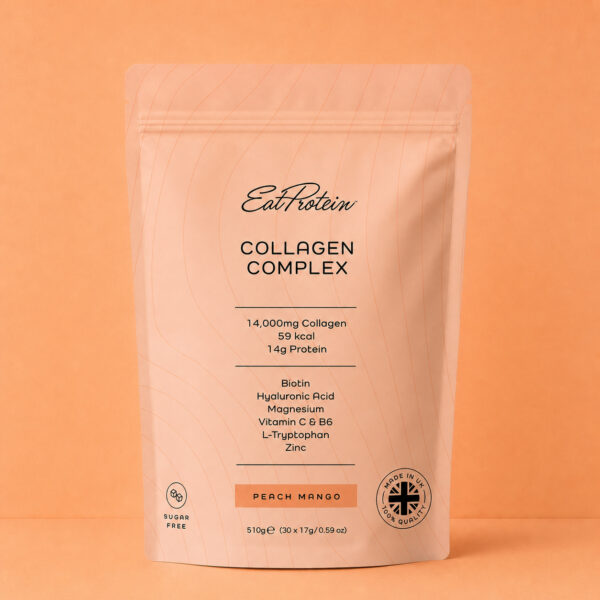
EatProtein’s Collagen Complex provides 14,000mg of hydrolysed collagen per scoop — towards the higher end of the doses tested in this research. A higher dose doesn’t fast-track the timeline; the tissue-building process still takes the weeks it takes. What it does is put you within the range where these results were actually observed.
What If You’re Not Seeing Results After a Few Weeks?
Two weeks in with nothing to show for it is completely normal — not a sign collagen “isn’t working for you.” None of the trials above found a meaningful result that early. Even the fastest-responding outcome, skin, needed 4 weeks just for the first tissue-level change to register on clinical measuring equipment, and 8–12 weeks before it was something you’d actually notice.
The realistic checkpoint is 8–12 weeks for skin, and closer to 24 weeks for nails and joints. Keep taking it daily through that window — skipping days is the most common reason people don’t see the results the trials found — and hold off judging it until you’ve reached the timeframe the evidence actually covers.
References
- Asserin, J., Lati, E., Shioya, T., & Prawitt, J. (2015). The effect of oral collagen peptide supplementation on skin moisture and the dermal collagen network: evidence from an ex vivo model and randomized, placebo-controlled clinical trials. Journal of Cosmetic Dermatology. View source
- Proksch, E., Schunck, M., Zague, V., Segger, D., Degwert, J., & Oesser, S. (2014). Oral intake of specific bioactive collagen peptides reduces skin wrinkles and increases dermal matrix synthesis. Skin Pharmacology and Physiology. View source
- Kim, D. U., Chung, H. C., Choi, J., Sakai, Y., & Lee, B. Y. (2018). Oral Intake of Low-Molecular-Weight Collagen Peptide Improves Hydration, Elasticity, and Wrinkling in Human Skin: A Randomized, Double-Blind, Placebo-Controlled Study. Nutrients. View source
- Bolke, L., Schlippe, G., Gerß, J., & Voss, W. (2019). A Collagen Supplement Improves Skin Hydration, Elasticity, Roughness, and Density: Results of a Randomized, Placebo-Controlled, Blind Study. Nutrients. View source
- Hexsel, D., Zague, V., Schunck, M., Siega, C., Camozzato, F. O., & Oesser, S. (2017). Oral supplementation with specific bioactive collagen peptides improves nail growth and reduces symptoms of brittle nails. Journal of Cosmetic Dermatology. View source
- Clark, K. L., Sebastianelli, W., Flechsenhar, K. R., Aukermann, D. F., Meza, F., Millard, R. L., Deitch, J. R., Sherbondy, P. S., & Albert, A. (2008). 24-Week study on the use of collagen hydrolysate as a dietary supplement in athletes with activity-related joint pain. Current Medical Research and Opinion. View source
- McAlindon, T. E., Nuite, M., Krishnan, N., Ruthazer, R., Price, L. L., Burstein, D., Griffith, J., & Flechsenhar, K. (2011). Change in knee osteoarthritis cartilage detected by delayed gadolinium enhanced magnetic resonance imaging following treatment with collagen hydrolysate: a pilot randomized controlled trial. Osteoarthritis and Cartilage. View source
- Kim, Y., Lee, J. O., Lee, J. M., Lee, M. H., Kim, H. M., Chung, H. C., Kim, D. U., Lee, J. H., & Kim, B. J. (2024). Low Molecular Weight Collagen Peptide (LMWCP) Promotes Hair Growth by Activating the Wnt/GSK-3β/β-Catenin Signaling Pathway. Journal of Microbiology and Biotechnology. View source